
Reflections from Davos.
Why empathy, hunger, and decency are your competitive edge.
I went to Davos expecting conversations about geopolitics and AI. I came home thinking about what it means to stay human in a world surrounded by technology that is accelerating faster than we can predict.
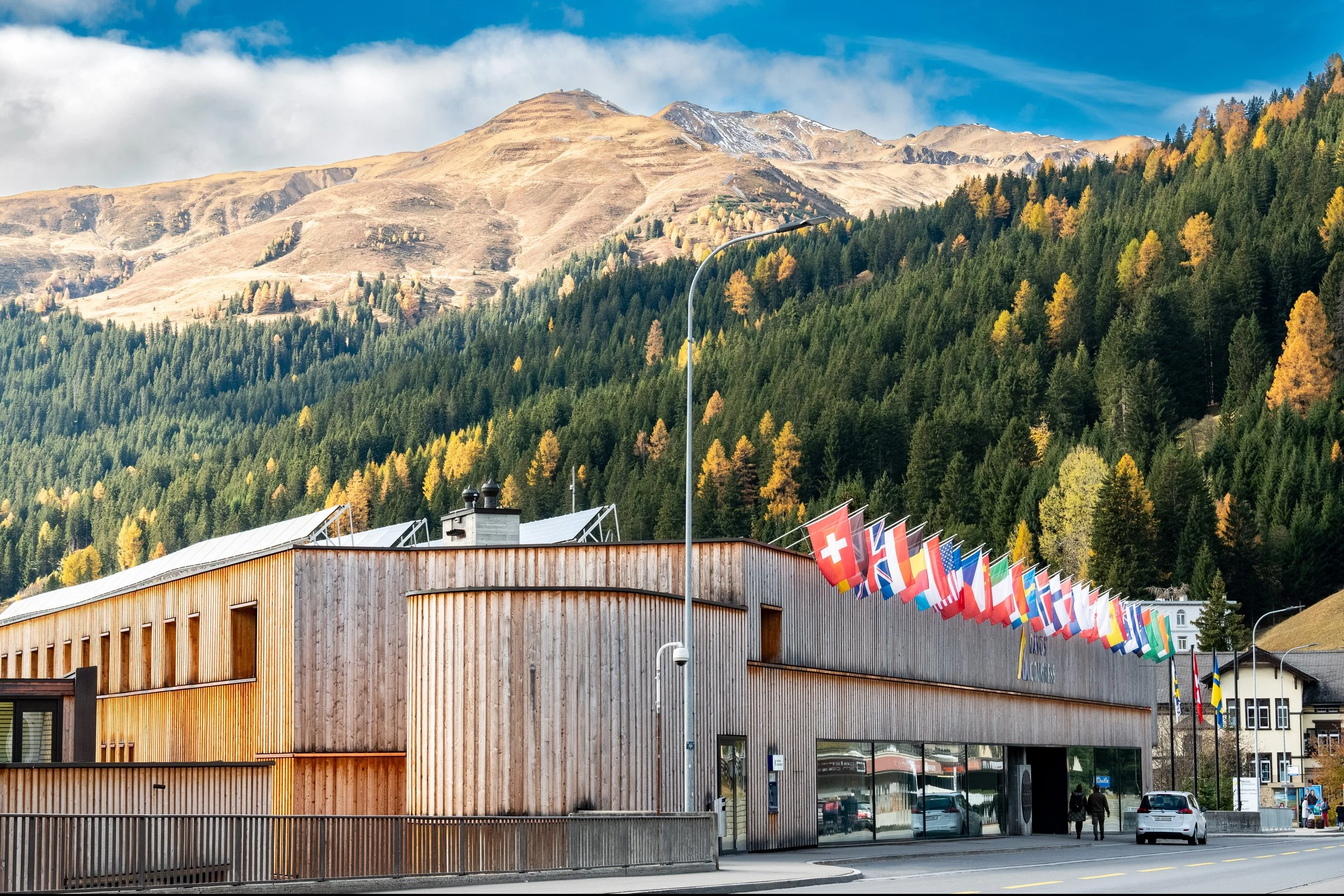
Last month, I traveled to the mountaintop at Davos during the World Economic Forum.
"A Spirit of Dialogue" was this year’s theme. And several key topics on cooperation in a contested world, unlocking real value from AI, creating new growth opportunities, building prosperity, and investing in people. From what I observed, President Trump was at the center of every conversation, with many people openly expressing strong opinions about geopolitics.
I was expecting lots of discussion on geopolitics and, of course, on where AI is headed. I got both. But by the end of the week, I realized that the world as we know it is changing drastically, especially from a deglobalization and new world order perspective. And, the thread that kept pulling me in was something else: how do we stay human in a world that is accelerating beyond our ability to predict it?
Here is what I took home.



The economy
Resilient, but shifting underneath.
The world economy has been surprisingly resilient despite shocks and tariffs. WEF's chief economists are less pessimistic this year, 53% negative, compared to 72% a year ago. Tariffs caused a global shake, and we have not yet seen a negative impact on economies. International trade hit a record $35 trillion in 2025. But underneath the topline, things are shifting in ways that feel permanent.
What stuck with me most was an insight from Neela Richardson of ADP. She described the U.S. labor market as structural rather than cyclical, meaning there is not a short-term fix. Everyone is feeling this shift, from individuals to every size business.
Small businesses, which employ three out of four U.S. workers, now have to factor in global issues like supply chains, trade policy, demographics, and AI when making hiring decisions. That is not the world of five years ago. Whether you are on Main Street or Wall Street, today’s business leaders have to deal with many hot issues, on average up to ten, compared to only a few in the past. That’s a drastic mindset shift both operationally and strategically.
Global growth is overall slow, below 2% this year. The World Bank estimates global output at 2.6%. India continues to shine as the Asian miracle, with growth at 6.2%. China is slowing to 4.2%. Japan sits at 0.6%. One economist called Japan the canary in the coal mine. Germany is committed to spending 10% of its GDP on infrastructure over the next decade. It is a cultural shift for a country with financial discipline and a dislike of deficits. The tech industry is issuing debt to fund AI investments instead of using retained earnings. We may be entering a period of structurally higher interest rates. National debt, energy, AI spending, and the workforce are all top of mind for unlocking both local and global growth.
One line kept repeating and stayed with me: "It's better to be an optimist who's wrong than a pessimist who's right."
I will take that bet every time.
Artificial intelligence
Diffusion is the story now.
I was pleasantly surprised to hear this topic as I walked around Davos. Agentic AI sessions and discussions were everywhere. Walking down the street, the presence of tech companies was more evident than ever. Microsoft’s Satya Nadella was keen on using AI and changing work through technology. That’s a mindset shift, and AI needs to be diffused across people, organizations, and societies.
But beneath the noise, we need to think about redesigning the workflow, not just the task. Andrew Ng was the clearest voice on why most AI transformations stall. His point was so sharp: "If you only automate one piece of the puzzle, you still have the old model. To get real value from AI, you have to redesign the workflow."
I have lived this. Automating a single part of a workflow can save hours. But the real shift happens when you rethink the entire flow and process: who gets what, in what format, how often, and what they do with it. Even challenging the status quo and how it could be done better. Not necessarily from the sense of speed only, but from the sense of betterment. That is an operating model change that I like to call “a spirit of continuous improvement”. Not a tool swap.
Most bottom-up AI innovation hits a ceiling because the rest of the process stays the same. The breakthrough requires a top-down view and a task-level understanding to work together. That is the hard part, and it takes reimagination and time. And it is why this is a business-and-people transformation led by technology, not the other way around.
Job market
Nuances behind the headlines.
Eric Schmidt was blunt: displacement is real in customer service and entry-level programming. But he also offered a line I kept thinking about long after his session: "Good news and bad news will come together. Expecting only good news from AI is a recipe for disaster. Keep your BS meter on."
Andrew Ng added the nuance I needed. For most jobs, 30-40% of tasks can be done by AI. You still need humans for the rest. But a human who uses AI will replace a human who does not. On his own AI-native teams, the ratio of product managers to engineers is approaching one-to-one because AI accelerated coding, but not the harder work of deciding what to build. The value of syntax is going to nil. The value of human judgment is going up. Judgement, indeed, is the difficult part.
And, there is the "AI is taking jobs" narrative dominating headlines. How the jobs get done is changing. Such a shift requires thinking micro at times. Of course, we need to look at the big picture, but the devil is in the details at times. One unanticipated research finding was that heavy use of agents actually reduced inter-team interaction. In general, productivity gains are measurable, so we understand the consequences. However, relational costs are harder to measure right away until they compound. That tension stayed with me. There is so much more beneath the surface we don’t see.
Another structural shift is coming that deserves more attention: the rise of very small companies. If AI enables one-person or two-person teams to do the work of twenty, the benefits will reach far beyond a single company. As AI-native people increase, so will their opportunities. This shift will highlight that AI-powered growth and financial success are not exclusively available to large companies but also to individuals throughout their careers. That’s a different way of thinking than our current systems, which are designed at the company level. Empowering the small teams opens up opportunities for growth and the design of quality-of-life benefits, including benefits, insurance, and retirement, that are rarely considered when discussing AI-driven changes.
Voices
The contrarian perspective.
Yann LeCun was the voice I needed to hear. He doesn’t like the term AGI. I totally concur. There is no doubt that systems smarter than humans will be built. However, when it comes to human intelligence, it isn’t 'general.' Calling AGI 'human-level AI' is a misnomer. Human intelligence is not general. He prefers the term AMI to AGI: Advanced Machine Intelligence rather than Artificial General Intelligence. The former means "friend" in French.
His argument resonated with me. AI is a technology trained on the language we use on the internet, in books, magazines, articles, and other resources that reflect our humanity and knowledge. AI’s intelligence is different than human intelligence. And, it is still a human technology, and how we relate to it matters.
When it comes to agents, LeCun had some concerns. Building agents on current LLMs, in his view, is a recipe for disaster. How can a system plan actions if it cannot predict consequences? We need systems that understand the physical world and build predictive models of their environment. Remember, LLMs predict the next word. The real world is more complicated than that. This made me think about our ability to use common sense. AI does not yet encompass that ability.
On open models, the consensus, not surprisingly, is that they are essential. AI power concentrated in a few companies poses a big risk to our society. LeCun pushed back hard on alignment as a framework: we can never guarantee safety, and pretending we can is dangerous.
Yuval Noah Harari framed AI differently than anyone else. In his view, the biggest immigration wave in human history is underway. Hundreds of millions of “AI immigrants” are entering every society. Unfortunately, the record on how humans handle immigration has not been encouraging. His concrete proposal? An immediate international agreement to never recognize AI as legal persons. It may sound extreme. However, the notion is that if AI can manage corporations without a human in the loop, no one bears liability or moral responsibility. That line should be drawn now.
His deeper point is memorable. There will be mistakes with AI, no matter what we do. So build self-correcting mechanisms. Do not assume we will get it right the first time.
And then, there was will.i.am. With so much style and substance. He emphasized our changing behaviors and tech. People spend their most private conversations with AI, and the risk is what he called conversational dysmorphia: becoming impatient with human response times. Because machines are instantaneous, we have already become inhumane to one another. We cannot let AI make it worse at a time when we need to be more human than ever. In some ways, robots are becoming more human, and we are becoming less human. It can’t be the future we create.
On creativity, will.i.am was clear. He doesn’t believe in AI’s ability to imagine. It learns from what we have done. Data and AI companies now know more about people than spouses or partners do. That nuance has been a concern for quite a while. We have been giving ourselves away because we never had such powerful tools in our hands. So, in a world where machines predict you, his advice was to be unpredictable.
His words of wisdom that I think capture our humanness are:
"You can prompt your life, not just with words, but with people. We are the neural network that materializes your future."
The people around us determine what gets built.
Leadership
Empathy, hunger, and decency.
The sessions on leadership, especially those organized by Female Quotient, stood out for the clarity they lacked on the bigger-stage panels. Industries and culture are evolving faster than we can imagine, and our leadership models need to evolve with them.
What stands out so far is not creativity or curiosity. Those have been overused.
Judgment is the strongest and most valuable human skill. Not skills like data analysis or technical fluency. Judgment as moral judgment: knowing what is right and what is wrong, including the ability to exercise agency. Empathy and emotion as operational competencies, not soft skills to mention in a values statement and forget.
IQ may get you in the room, but AI is commoditizing it. EQ is how you lead. It’s the ability to make decisions that account for the human cost, not just the business case. As AI is becoming a spirit of speed, understanding people is what separates a good decision in practice from a right one on paper. Empathy is strategic.
One line you might have heard in the last few years is: AI is the IQ; humans have EQ + DQ. To that end, DQ was mentioned in several panels and conversations. These skills collectively represent our humanity, what makes us uniquely human.
IQ + EQ + DQ.
DQ is the Decency Quotient. How you treat people, with kindness, with respect, with basic human decency, is not just a nice-to-have. It is a competitive differentiator. In a world where AI can match or exceed your IQ, emotional intelligence can be developed through coaching or training. Decency becomes the thing that cannot be automated. It is the alpha.
Hunger also matters. I have usually hired for passion rather than for skills. People who are hungry to succeed, excel, grow, and do better bring so much to the table. In practice, it is a daily operating behavior. Even during tough times, when you are leading a team through uncertainty, it looks like planting seeds outside your domain. It looks like ruthless prioritization paired with the humility to say, "I don't know yet, and I will figure it out." Because in the age of AI, ambiguity is high.
Transferable skills are the new credentials. On average, people have around 30 pivots during their careers. No one has a linear path anymore. Different occupations and training bring a multitude of experiences to the workplace.
This practical advice was refreshing: learn the tools, get good at one, and build from there. Domain expertise paired with AI fluency is a durable investment for individuals and businesses alike.
And there was a line that hit differently after four days of panels and meetings: "Nobody has a clue, because we are the last generation to lead humans alone." The next generation of leaders will lead hybrid teams. Humans and AI working together. The playbook for that does not exist yet. Learning fundamentals, such as learning to learn and pursuing continuous improvement, are what the future of work requires. Learning to learn. Expertise will change.
The ability to learn and adapt will not.
What does exist is a set of personal operating principles as we are experiencing this shift:
Slow down now to speed up later
Follow your passion + pick your culture
Listen first
Recognize relevance over noise
Choose engagement over volume

I left Davos thinking about
the human aspect of the
new world order.
How we work together. How we engage. How we build trust. How we stay human
when the world is accelerating faster than we can predict.
As a travel and tourism professional, Davos made it clear how important the travel and tourism industry is to the new world order and the age of AI. Tourism is one of the few industries that brings people together at scale. In a world where people want prosperity, peace of mind, and community, tourism is a superpower at both the individual and collective levels.
I suggest we be audacious, be hungry to do better, and build a world forward together.
* * * * * *
As will.i.am said, “prompt our lives, not just with words, but with people. After all, we are the neural network.”
And in a particularly fractured world, let’s keep building bridges!
