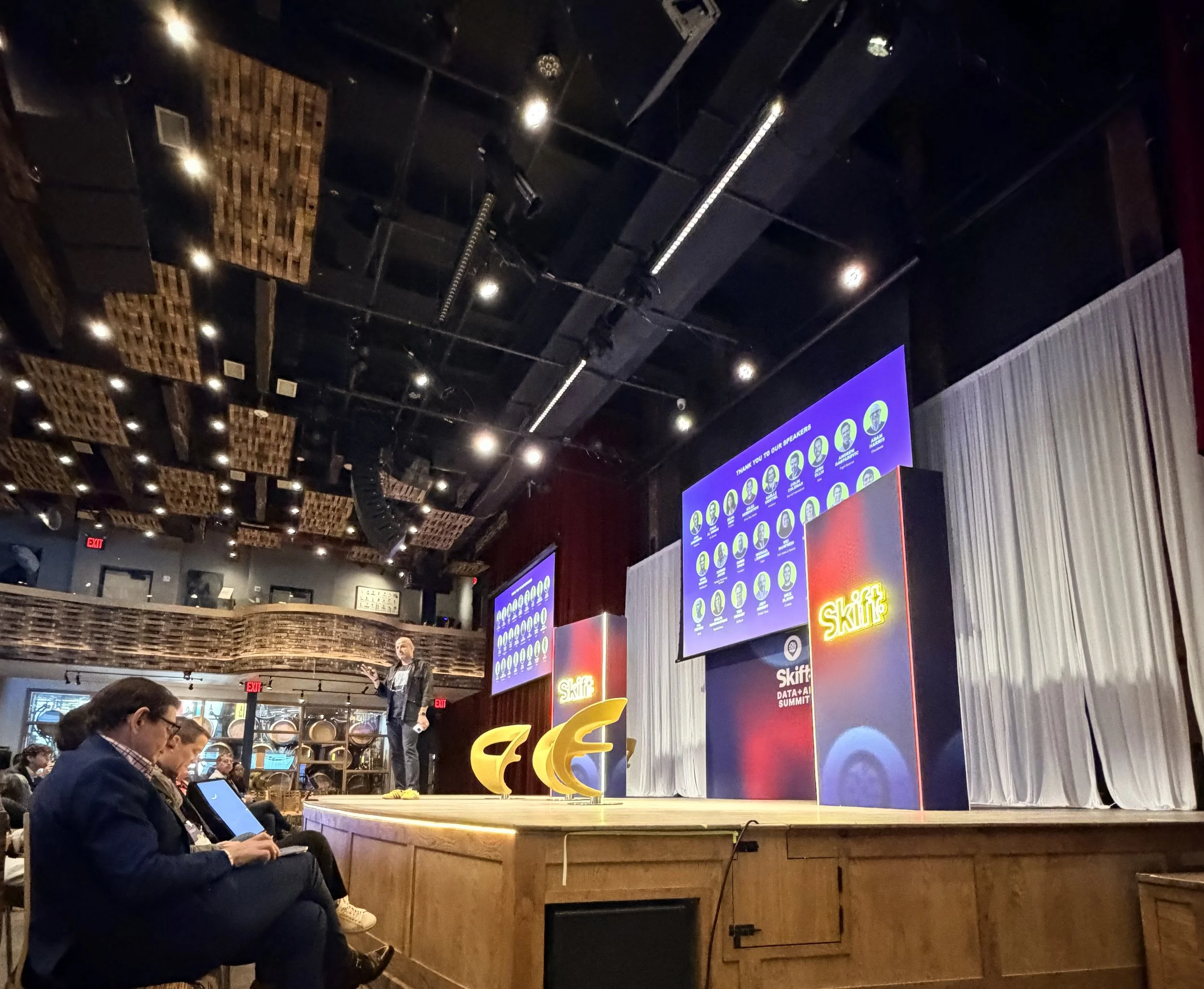
How travel is building AI.

Skift Data + AI Summit.
AI models have gotten good. The real work is the hard part: rewriting the organization. The harder work is in rewiring mindsets to see what’s possible and effectively act on it.
Skift’s Data + AI Summit has become one of my favorite events for bringing together diverse mindsets and viewpoints in the travel and tourism industry.
I was at its first event in 2024, where the discussion focused on excitement around AI. 2025 was about adoption and use cases, and this year was all about scale.
Innovation is happening in the shadows. This year’s content was built around five tensions:
Pilot vs. Production
Speed vs. Trust
Build vs. Buy
Control vs. Visibility
Cost vs. Revenue
All gray areas with lots of imperfections when it comes to choices and adoption. These tensions perfectly capture how we are all operating as we get comfortable with incomplete information and reimagine the future possibilities.
That lack of certainty applies to all sectors. I work with destinations. We don’t own the management systems. We don’t own the transactions. Our product is the place itself, and our data is scattered across a hundred partners who don’t report to us. The lessons across sectors still apply.
Here’s what I took away.
Skift offered a framework for considering how travel and tourism businesses are adopting AI. Every travel company is doing one of three things with AI.
Builders are integrating it into core production. They are building the data infrastructure, training internal teams, and scaling past the demo. Think Airbnb.
Reorganizers are changing how the daily work gets done, but haven’t committed to foa scaled to production. Think Carnival and American.
Renamers slap “AI” on a rules-based chatbot they shipped years ago and call it innovation. It fills a void when you don’t have a budget for customer service.
Regardless of where you sit in that framing, few have scaled it. That distance between what we say and what we actually do is the “say-do gap.” And it’s where the real business decisions live.
ACT I:
The first act of the day was about infrastructure:
Are you building on something that will hold?
Colin Coleman, SVP of Enterprise Data, Analytics, and AI at Marriott International, described becoming a “nerve system”. Think modularity. Modular enough to connect, like Lego blocks. The interesting work, he said, isn’t automation. It’s reengineering what teams actually do. A revenue manager shouldn’t start with the task. They should start with the outcome they’re trying to achieve, then optimize the flow toward it.
The foundation under all of this is data. Josh Ellis, co-founder and CEO of Abra, put it plainly: bad data equals bad AI. Guest information at hotels is fragmented, disorganized, and inaccessible. You can’t build intelligence on a backbone that isn’t there. Scale is about data quality built on it. Pressure test the data, not the model feeding into it. Then, build, scale, govern, and optimize.
ACT 2:
This was my favorite because this is where strategy either dies or is orchestrated.
Wei Manfredi, SVP of AI and Architecture at IHG Hotels & Resorts, offered advice that sounded almost anticlimactic: get back to basics. The boring, hard stuff. And remember, innovation is not all about technology. It is about people using it and how you reward them. The culture of the organization. You will have friction, and some friction is healthy. During our lunch roundtable with NVIDIA, our group discussed the role culture plays in creating friction. Not the good one. When adoption takes place, but organizational processes fail to evolve with it, you are left with unproductive friction. Employees may reject change while working within outdated processes and incentives. And yes, some employees will reject change. More often, it is a sign of misalignment, not resistance.
John Sturino, SVP of American Express Global Business Travel, framed an approach for agents: treat every agent as a new hire. In practice, an agent carries the same level of accountability as you would if you did the job yourself. You need someone who owns the outcome, whether it's from a human or an AI agent.
Jie Zheng of TUI Group, whose agents are built on TUI’s own AI assistant store, pushed similar thinking. She brought up the Actor framework, and it all starts with accountability. She also added that many business processes don’t just need to be automated; they need to be reimagined first. I had a chance to spend some time with her during the reception. I love the fact that she is big on being a fast adopter. Soon enough, AI will be embedded everywhere in the way we work, and how we work will continue to shift.
Here is more of the framework adapted from the London Visa GenAI talk. I immediately took a picture. Reliability ahead of novelty, and governance as operational, not aspirational, stayed with me.
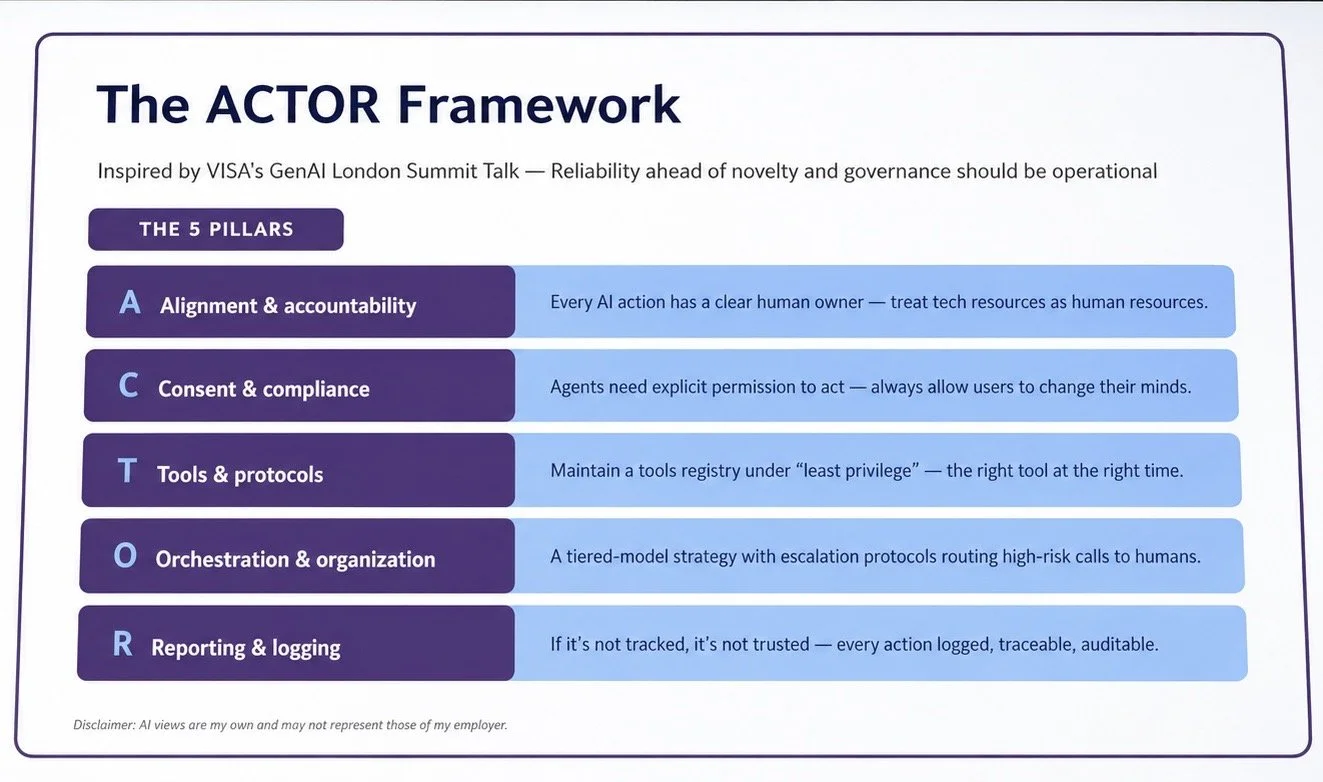
None of the deployment of AI is about the model capacity. It’s all about the wiring around the model: ownership, permission, escalation, and audit. That’s the part that matters.
Measurement has to stay practical, too. Travelport’s Fahim Khan, SVP of Product, warned against making the measurement more complicated than the process it measures. Track containment. Keep it usable. The point is an outcome that’s exciting.
ACT 3:
By this time, the conversation turned to money, and the startups got the hardest question of the day: What’s your moat? If someone copied you tomorrow, what
would they be missing?
Almost nobody had a clean answer. I hear this on investor calls, too. Everything is changing too fast. For example, voice has been commoditized in recent years, and trip planning to a degree. Startups built two or three years ago are already pausing and reevaluating what they’re doing.
So what holds?
Proprietary, differentiated data, combined with public, general models. Tom Romary of BizTrip AI named their moat as the data inside the corporate client, plus third-party data, plus execution. Not the model itself.
I loved how Expedia Group’s Shilpa Ranganathan, Chief Product and Technology Officer, put it. Operations is the skeleton. Data is the backbone. AI is the muscle. Agentic is the skin on the muscle. And the future belongs to human judgment because when AI gives you the answer, your job becomes evaluating it. We’re not in the business of providing electricity, she suggested. The real question is how we make it meaningful for the customer.
Build vs. buy got a useful correction, too: it’s build, partner, and buy.
Anything that touches customer data and privacy, Ranganathan said, anything you want to keep close (in other words, if it is a competitive advantage), that’s a build. The rest, you partner or buy. Being flexible is the point. When it comes to the DMOs, it is all of them, as well. The choices depend on needs and internal capacity.
My key takeaways:
Sejal Amin, CTO of Priceline, views the last 18 months as a cost-saving story driven by efficiency. The question now is when it becomes a money-maker. I would push on this because we are still in the early stages of money-making. The industrial revolution took at least three decades. Although the AI revolution is accelerating rapidly, we need to adjust our expectations as we are just three years into adoption.
Vipul Hingne, interim CTO of Booking.com, on the hardest part of all of this: figuring out the human experience. Everyone wants to point AI at the customer level. Few ask how AI genuinely improves the customer experience. The internal operational level matters a lot.
And Richard Valtr, founder of Mews, with the line that felt so true: nobody deserves to keep customers forever. You have to continually earn it. Rafat Ali emphasized how our industry needs more founder-led companies. We need more people who challenge the business as usual, the kind of people who are genuinely passionate about travel. There are too few of them. We need more of a founder mindset across organizations because transformation is not only about rewiring the organization, it is about rewiring mindsets. And that work starts from the inside out.
Technology may accelerate change, but people determine outcomes and whether that change creates value.
The real ROI question is about people and culture. Just because we have a hammer doesn’t mean everything is a nail. Invest in people and culture as much as the technology.
*********